AUSTRALIA
FEATURES
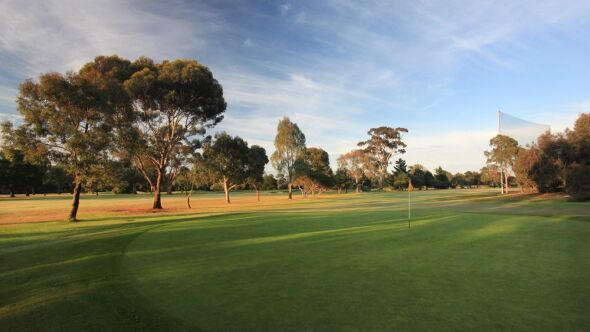
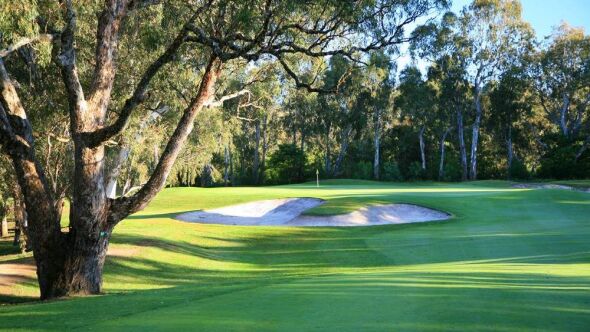
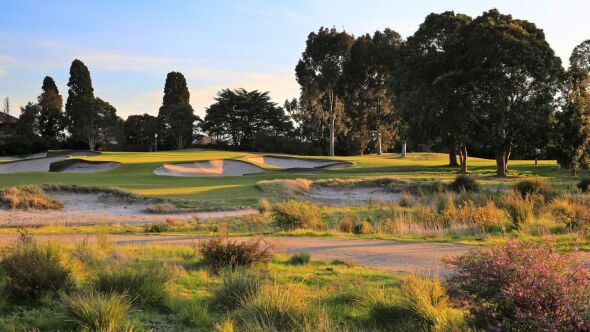
The Historic Sandbelt Region: Something for Every Type of Golfer
in Australia
By Shawn Nicholls, Contributor
MELBOURNE, AUSTRALIA -- A traveling golfer's dream destination
may go something like this: impeccable climate, exotic scenery,
and immaculate championship courses stooped in golf history.
Sound farfetched? Perhaps. After all, finding just a couple of
solid courses in one area is hard enough of a task, but a whole
collection of them? Just chalk that up to wishful thinking.
Wishful thinking, that is, to anyone who has not been to Australia's
famed Sandbelt region. Those who have experienced this stretch of
golf know that the dream destination does exist, even if it is on
the other side of the world.
About the Region
The state of Victoria is located at the southeastern tip of the Australian
mainland and is home to just under 400 golf courses. Its capital,
Melbourne, is roughly 12 hours away from Sydney, but those craving
golf need only travel south east of the city to the suburbs that line
the shore of the Port Phillip Bay. There sits a 25 square mile mass
of undulating land and delicate grass known as the Sandbelt.
Melbourne is a city all about variety, from its booming architecture,
to cozy cafes, to its vineyards. And this well-rounded quality extends
into the city's collection of golf courses, which, especially in
the Sandbelt, provide something for every type of golfer.
The most famous grouping of courses that makes up this region
is often referred to as the 'Seven Sisters,' and most have been
ranked at one time or another in worldwide golf publications.
But the beauty of the Sandbelt lies not just with the quality
of the courses, but also with the deep history associated with many
of the private clubs. In fact, the majority of these courses have
at one point or another been home to international tournaments,
with some of golf's greats gracing the fairways.
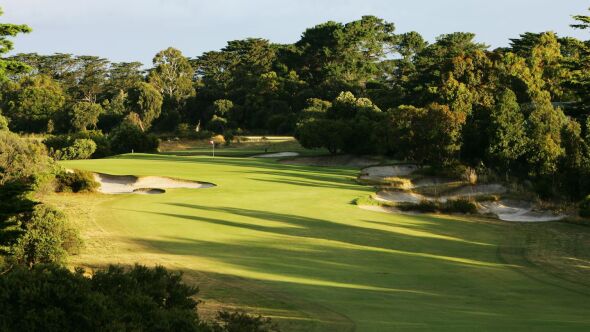
Royal Melbourne
At the forefront of the region's historical significance are the
Royal Melbourne's East and West courses. Both are links style tracks
measuring at right around 6,600 yards.
Allister Mackenzie, one of the most notable golf architects in
Australia, designed them, and the origins of the club date back
to the early 1900s, and perhaps before, making it the oldest in
the region.
Both courses at Royal Melbourne can arguably be referred to as
the best in Australia, and holes from both courses at Royal Melbourne
have often been combined to form a composite track, site to many
international events such as golf's World Cup and the President's
Cup in 1998.
Wide fairways and large greens are just a few of the characteristics
that make Royal Melbourne appealing. But don't confuse large landing
areas with an easy course, because every hole at this famous complex
is a challenge.
Just take No. 3 on the West course. Although the fairway is wide
and the hole rather short, it is the green that is the tricky part
of this par-4. It is perhaps the most frustrating on the course
because it slopes away from the fairway, making distance control
and a little bit of luck a necessity.
Find out more on the Royal Melbourne at www.royalmelbourne.com.au
Tel: +61 3 9598 6755
Victoria
Situated near Royal Melbourne, the Victoria Golf Club, ranked
as a top ten course on the continent by the Australian Golf Digest
magazine, requires a little bit of everything to score well. Flat
fairways give golfers a chance at level lies, something not always
the case at other area courses, but frustrating bunkers and looming
trees are this course's main obstacles.
The first hole is a unique par-4, measuring only 254 yards, but
a raised green and a few deep bunkers make it a formidable challenge,
but still a birdie opportunity. It is, by no means, an indication
of what is to come.
With several of the other par-4s measuring around or over 430 yards,
it is a safe bet that the par-5s stand to be lengthy monsters. But,
actually, on the scorecard they are not that intimidating, with
the 8th and 18th holes measuring close to 500 yards. By many, this
means letting the driver and fairway metal rip in hopes of rolling
up to the green for a chip and a putt and a nice birdie.
But the course may have something in for those rash in their decision-making.
The landing area on the 8th hole is very narrow, and the green,
strategically guarded by bunkers, is not one easily accessed from
200 to 250 yards back. Losing a second shot to either side of the
green, or even long is a disaster.
Similarly, the 18th is a fairly straightaway hole with trees looming
in the rough and a green that slopes from front to back. As a finishing
hole at a tournament, the 18th could yield anything from eagle to
bogey. And for those just getting a regular round in, an approach
shot that rolls off the green and is not stopped by a gallery, could
net an even worse tally.
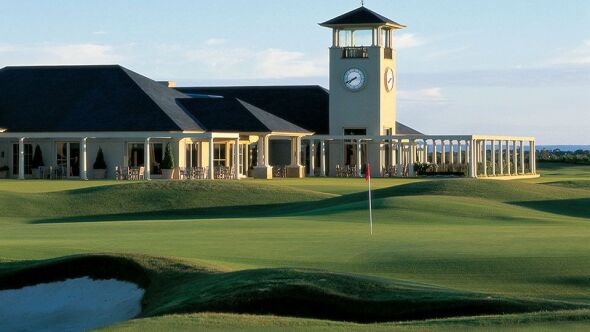
Aside from great golf, the Victoria Golf Club provides immaculate
accommodations, including a state of the art clubhouse and beautiful
guest rooms. But it is one of the more popular private courses,
so tee times and open rooms fill up quickly.
Find out more about the Victoria Golf Club at www.victoriagolf.com.au
Tel: +61 3 9584 1733
Kingston Heath
Challenging the Royal Melbourne for top honors is the Kingston
Heath. It was designed by Dan Soutar in 1923, and updated to include
bunkers in 1927 by Mackenzie. Tight fairways, lengthy par-4s and
dangerous obstacles such as trees and bunkers are this course's
most infamous attributes.
While the Victoria Golf Club eases golfers in with a short first
hole, the Kingston Heath is much less accommodating. At 457 yards,
the first could easily could be a par-5, but is instead just a nasty
par-4, requiring just about every shot in the bag. The tee-shot
is uphill, but don't get to comfortable with this style of ball
striking, because the second shot is downhill towards a well protected,
massive green.
Ready for a break, yet? Don't expect one. The second hole is a
sharp dogleg left, and bunkers will prevent many from cutting too
much off the corner, while the third hole is short at only 295 yards,
but it may be best to keep the driver in the bag, or even the 3-wood
for that matter, because of the trees and bunkers. Of course, finding
the fairway does not guarantee much, as the undulating green does
not hold all shots, sending them rolling into the rough or yet another
bunker.
As you stagger into the clubhouse, pause to admire the plaque
in the fairway of the par-5 14th, where Roger Mackay registered
a double-eagle in 1979 during the Victorian Open. But don't be too
discouraged if you triple Mackay's score, as this is one of Australia's
best holes, but by no means a pushover.
Find out more about Kingston Heath at www.kingstonheath.com.au
Tel: +61 3 9551 1955
Metropolitan
From one triumphant piece of history to one of sorrow, one of the
Sandbelt's other most popular courses, the Metropolitan, was home
to the Australian Open in 1997.
Familiar to letdowns in the major title chases of past years,
Greg Norman surrendered a two stroke lead over the final two holes
to Lee Westwood, with Norman eventually missing a three foot putt
for par on the fourth playoff hole to hand the victory to the up
and coming Westwood.
But don't get to caught up in the drama of the 17th and 18th at
the Metro, because the other 16 holes on this par-73, tree lined
course are worth your attention.
Find out more about the Metro at www.metropolitangolf.com.au
Tel: +61 3 9579 3122
Commonwealth
The one course of the seven that does not conform to the Sandbelt
mold is the Commonwealth Golf Club, the host of the 1967 Australian
Open.
Since then, the club has fallen in the eyes of many, and its ranking
fell out of the world top-100. But don't necessarily count the course
out.
"In 2000, the Club set about re-establishing Commonwealth's standing
in the golfing world and today the course does resemble the course
of old," general manager Greg Chapple said. "Much work will continue
over the next five years to reinstate some of the values of the
course in years gone by."
At just under 7,000 yards, the par-73 course will challenge any
skill level throughout, but at the same time, several of Commonwealth's
holes are much more dangerous than the rest.
Take for instance the three, and only three, holes in which water
comes into play. Particularly challenging are the tee shots on the
3rd and 16th holes, which border the same body of water. No. 3 only
requires a straight tee shot to find the fairway, with those prone
to the slice perhaps getting a little wet.
But the 16th will surely test the courage of all golfers. Avoid
the water too much, and this dogleg to the left suddenly becomes
a very long hole. Cut the corner too much, and you may be hitting
three sooner than you would like to.
The one constant at Commonwealth, however, is the secluded feeling
golfers will get as they plod along on the tree-lined fairways towards
the 18th hole and the historic clubhouse, well known throughout
the region.
"The main feature that sets Commonwealth golf course apart from
its fellow Sandbelt courses is our trees," Chapple said. "The trees
that line our fairways have long been considered to be amongst the
finest stands in this country with the result that Commonwealth
is revered for its challenging driving holes."
Find out more about the Commonwealth Golf Club at www.commonwealthgolf.com.au
Tel: +61 3 9579 3033
Huntingdale
The golf club at Huntingdale is the baby of the Sandbelt, having
opened in 1941. But at the same time it holds one of the most prestigious
events in the region as professionals get to test the slick and
massive greens at this par-73 course yearly during the Australian
Masters.
As is the constant in the area, most of the fairways are lined
with hovering trees and bunkers. Golfers will find challenges throughout,
as the par-3s require just as much strategy and mental toughness
as the long par-5s require strength.
The 18th is considered to be one of the toughest finishing holes
anywhere. A tee shot that veers off to the left may catch deep bunkers
that can easily ruin a good round. But don't favor the right, as
there is nothing nice over there either. Bunkers continue to be
a bother left and short of the green, as this hole requires precision
from start to finish.
Find out more about Huntingdale at www.huntingdalegolf.com.au
Tel: +61 3 9579 4622
Yarra Yarra
The first thing that you find interesting at the site of the women's
Australia Open is the layout, which situates the practice range
and the first eight holes on one side of the clubhouse and parking
lot, with the rest on the other side. Golfers also get to preview
the challenging finishing hole as they walk down the 10th fairway.
The 5th at Yarra Yarra is rated as one of the top 500 holes worldwide
and challenges golfers with its fairway and greenside bunkers. The
10th requires an accurate tee shot, but a very precise second shot
to a green protected in the back by a lake.
If the challenge of avoiding the water at the 10th isn't enough
to get your blood pumping on the second nine, No. 11 surely will.
Ranked as one of the top-15 holes on the continent, this out of
the way par-3 may not be lengthy, but miss the green in any of the
several deep bunkers, and your walk to the 12th tee will not be
a pleasant one.
Find out more about Yarra Yarra at www.yygc.com.au
Tel: +61 3 9563 7711
|